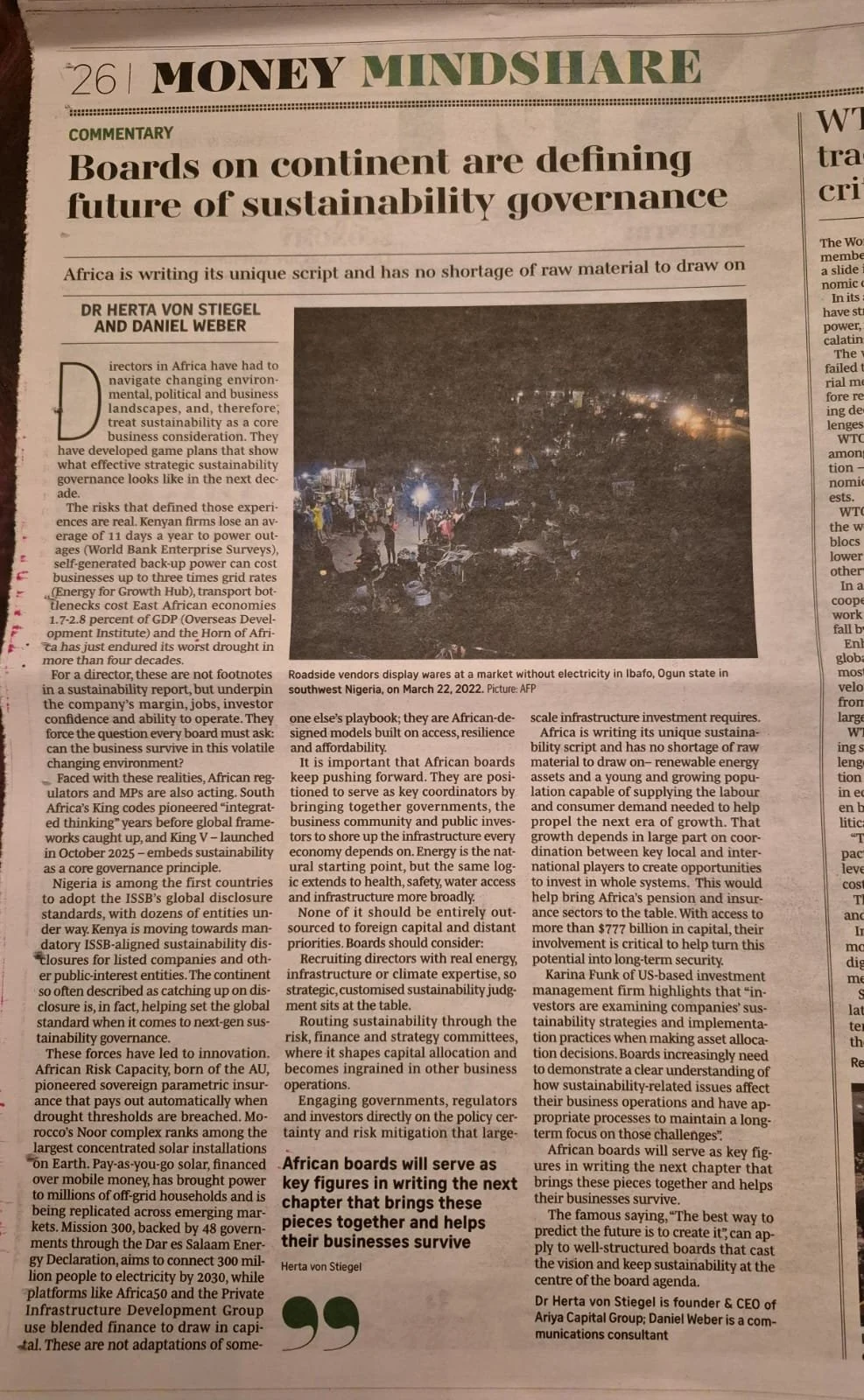
Herta von Stiegel Featured in The EastAfrican: African Boards are Defining the Future of Sustainability Governance
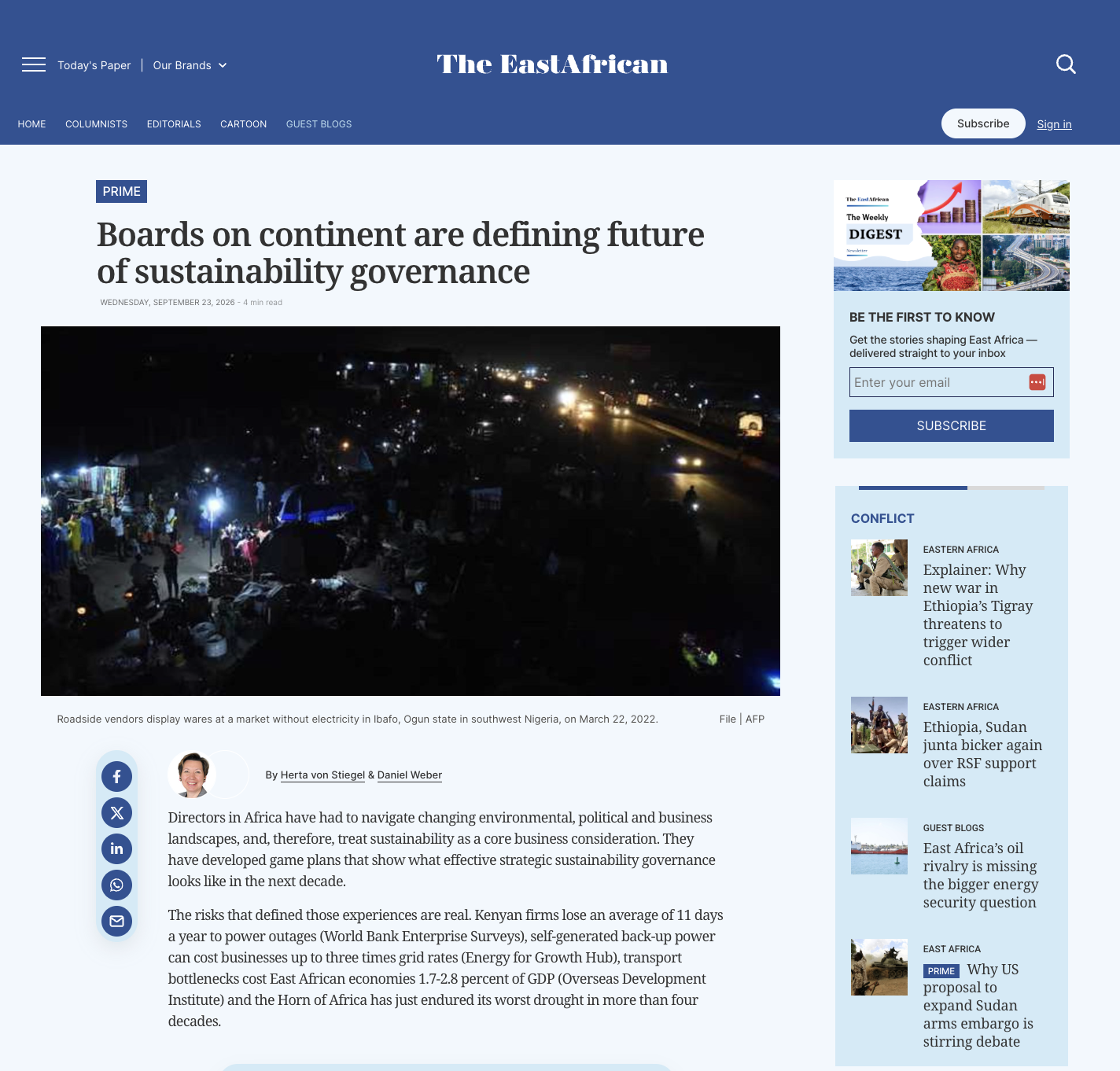
Herta von Stiegel Featured in The EastAfrican: African Boards are Defining the Future of Sustainability Governance
Originally published in The EastAfrican, this op ed by Dr Herta von Stiegel and Daniel Weber explores why African boards are increasingly well placed to shape the next era of sustainability governance. Drawing on the practical realities businesses across the continent face, the article argues for a model rooted in resilience, access, long term value and African led solutions.
The original article is available to The EastAfrican subscribers. We are reproducing it in full below for wider access.
African Boards are Defining the Future of Sustainability Governance
By Dr Herta von Stiegel and Daniel Weber
When the power goes out in a Lagos factory, or a failed rainy season empties the reservoir behind a hydropower dam, sustainability stops being an abstract reporting exercise and becomes a board-level survival question. African directors have had to navigate changing environmental, political, and business landscapes for years, therefore treating sustainability as a core business consideration. As a result of that experience, they’ve developed formidable game plans to work from, which show what effective, strategic sustainability governance looks like in the next decade, not the last one, and positions African boards to help shape the next era of global sustainability governance.
The risks that defined those experiences are real. Kenyan firms lose an average of 11 days a year to power outages (World Bank Enterprise Surveys), self-generated backup power can cost businesses up to three times grid rates (Energy for Growth Hub), transport bottlenecks cost East African economies 1.7–2.8 percent of GDP (Overseas Development Institute), and the Horn of Africa has just endured its worst drought in more than four decades. For an African director, these are not footnotes in a sustainability report, but underpin the company’s margin, jobs, investor confidence, and ability to operate. They force the question every board must ask: can the business survive in this volatile, changing environment indefinitely? That question belongs on the agenda of every board meeting.
Faced with these daily realities, African regulators and legislators are also acting. South Africa’s King codes pioneered “integrated thinking” years before global frameworks caught up, and King V, launched in October 2025, embeds sustainability as a core governance principle rather than a separate workstream. Nigeria is among the first countries anywhere to adopt the ISSB’s global disclosure standards, with dozens of entities already underway, and Kenya is also moving toward mandatory ISSB-aligned sustainability disclosures for listed companies and other public-interest entities. The continent so often described as catching up on disclosure is, in fact, helping set the global standard when it comes to next-gen sustainability governance.
These forces have led to innovation across the continent. African Risk Capacity, born of the African Union, pioneered sovereign parametric insurance that pays out automatically when drought thresholds are breached — a model now studied worldwide. Morocco’s Noor complex ranks among the largest concentrated solar installations on earth. Pay-as-you-go solar, financed over mobile money, has brought power to millions of off-grid households and is being replicated across emerging markets. Mission 300, backed by 48 governments through the Dar es Salaam Energy Declaration, aims to connect 300 million people to electricity by 2030, while platforms like Africa50 and the Private Infrastructure Development Group use blended finance to draw in local capital. These are not adaptations of someone else’s playbook; they are African-designed models built on access, resilience, and affordability.
Given these unique perspectives, it is important that African boards keep pushing forward. They are well positioned to serve as key coordinators by bringing together governments, the broader business community, and public investors to shore up the infrastructure every economy depends on. Energy is the natural starting point, but the same logic extends to health, safety, water access, and infrastructure more broadly. None of it should be entirely outsourced to foreign capital and distant priorities; it is best secured by Africans, for Africa. In practice, that means boards should consider:
Recruiting directors with real energy, infrastructure, or climate expertise, so strategic, customized sustainability judgment sits at the table.
Routing sustainability through the risk, finance, and strategy committees, where it shapes capital allocation and becomes ingrained in other business operations, rather than isolating it in a standalone committee.
Engaging governments, regulators, and investors directly on the policy certainty and risk mitigation that large-scale infrastructure investment requires.
Africa is writing its own, unique sustainability script, and it has no shortage of raw material to draw on: renewable energy assets among the richest in the world; a young and growing population capable of supplying both the labor and consumer demand needed to help propel the next era of growth. That growth depends in large part on sustained coordination between key local and international stakeholders to create opportunities to invest in whole systems, not just projects. This approach would help bring Africa's pension and insurance sectors to the table; with access to over $777 billion in capital their involvement is critical to help turn this potential into long-term security.
Karina Funk, Portfolio Manager and Chair of Sustainable Investing at Brown Advisory, a US-based investment management firm with over USD 180 billion of assets under management and a range of sustainable investing strategies, highlights that “investors are examining companies’ sustainability strategies and implementation practices when making asset allocation decisions. For boards, these considerations extend beyond compliance. Boards increasingly need to demonstrate a clear understanding of how sustainability-related issues affect their business operations and have appropriate processes in place to maintain a long-term focus on those challenges.”
African boards are at the center of that progress and those discussions. They will serve as key figures in writing the next chapter that brings these pieces together and helps their businesses survive whatever sustainability-related challenges the future might hold.
The famous saying, "The best way to predict the future is to create it," can equally be apply to well-structured African boards that cast the vision and keep sustainability at the center of the board agenda.
Dr Herta von Stiegel is Founder & CEO of Ariya Capital Group, a member of Brown Advisory’s Sustainable Investing Advisory Board, and former Chair of Britam Asset Managers (Kenya).
Daniel Weber is a Communications Consultant for Ariya Capital Group.